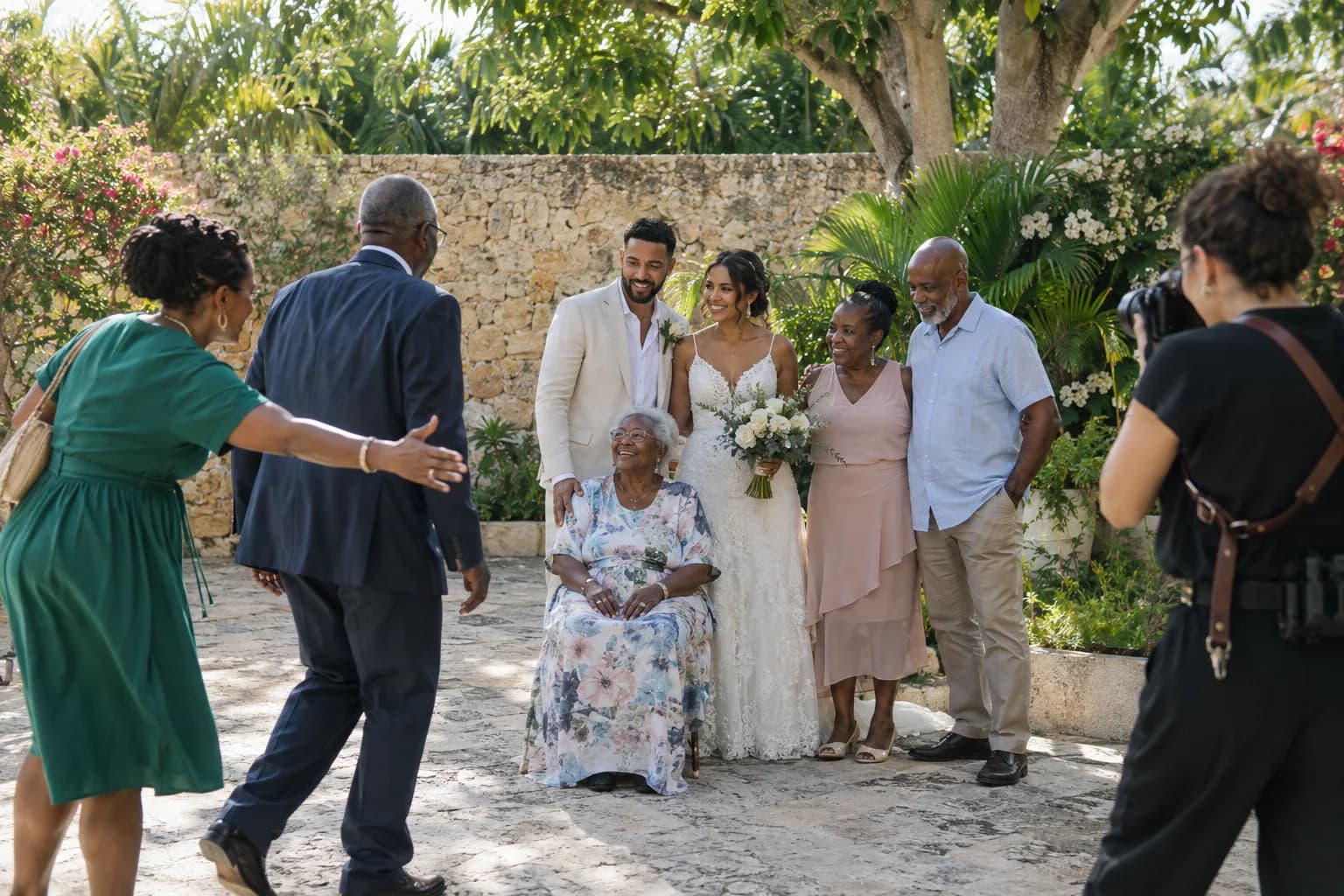
What belongs on the family photo list?
Start with the people whose absence from a formal portrait would matter most. Many couples want photographs with parents or caregivers, siblings, grandparents, and children. Chosen family may be just as important. There is no required order of relatives or standard set of combinations.
Use this working table before you send anything to your photographer. Its rows are examples, not a prescribed shot list; replace the relationship labels with actual names in the private version you share.
| Priority | Possible grouping | Names to confirm | Person who can gather the group |
|---|---|---|---|
| Must have | Couple with one partner's parents or caregivers | Add actual names | Choose a relative or planner |
| Must have | Couple with the other partner's parents or caregivers | Add actual names | Choose a relative or planner |
| Must have | Couple with siblings and children on each side | Add actual names | Choose someone who knows them |
| Must have | Couple with grandparents or older relatives | Add actual names | Arrange easy access |
| Optional | Both immediate families together | Add actual names | Confirm everyone is present |
| Optional | Chosen family or a close-friends group | Add actual names | Choose a group contact |
Ask the photographer whether this many groupings fit your actual schedule. A list is a way to set priorities, not a guarantee that every variation can happen within a short coverage window. The wedding collections currently range from four hours to up to eight hours, so the time available for family portraits depends on the rest of the day too.
How do you make the list usable on the wedding day?
Names beat labels. “Couple with Sam, Jo, and Aunty Dee” is more useful to the person gathering relatives than “maternal family.” In the private working copy, add the name each person answers to, especially when several guests share a surname. Decide whether partners, children, or step-relatives belong in each group before the ceremony.
Keep one final version. If the couple, planner, and photographer are each holding a different list, time gets lost resolving which one is current. A straightforward process is:
- Ask each partner for their non-negotiable groups independently.
- Combine duplicates and settle any sensitive family combinations privately.
- Verify travel and attendance with the people who know the guests.
- Mark a clear priority for every group.
- Share the final named list with the photographer and the two people gathering guests.
- Recheck it after any late travel cancellation or change in family circumstances.
If family relationships are complicated, write a short private note for the photographer instead of explaining the situation in front of everyone. The goal is to let people feel comfortable, not to force a grouping because a template suggested it.
When should family portraits happen?
The practical answer depends on where guests will be, when the ceremony ends, and how far the portrait location is from the reception. Immediately after a ceremony can work because most guests are present, but it can also conflict with transport or a short venue changeover. A first look may move some immediate-family portraits earlier if everyone involved agrees and is ready.
Walk through the sequence with your photographer and planner. If the ceremony is outdoors, ask about shade or a sheltered option for group portraits. Barbados light, wind, and sudden weather changes affect comfort as well as photographs; the outdoor ceremony guide gives a broader planning context. Do not assume a beautiful ceremony backdrop is also the easiest place to hold a group together.
Leave transition time around the portraits. A sample plan might reserve a portrait window after the ceremony, followed by couple portraits while guests continue to the reception. That is an illustrative sequence, not a promise that every wedding can use it. The correct window comes from the venue layout, number of groups, guest needs, and coverage hours.
Who should gather the people?
Pick one person from each side who knows the names and will be available. A planner or coordinator may help, but confirm that role rather than assuming it. The photographer should be able to concentrate on arranging and making the portraits while the gatherers bring the next group into place.
Tell guests who are in a must-have portrait when and where to remain after the ceremony. A short instruction on the wedding website or in a private message is enough. Avoid announcing a long list to everyone during the reception; it is easier to gather the relevant people before they disperse.
What should you leave off the list?
Skip endless near-identical combinations unless each one matters to someone. A formal list is best for people you cannot reliably assemble later. Candid photographs of guests talking, laughing, and celebrating are a different part of the coverage and do not need individual instructions. JSobersPhotography describes a documentary approach; use the list for essential posed groups and leave room for the rest of the story to unfold.
Before finalizing coverage, send your must-have groups, approximate guest count, ceremony location, and reception location through the contact form. Ask the studio to review the portrait window in your timeline. You will then know whether the list fits the day you are planning, rather than discovering its real length after the ceremony.